Business texting: send the texts customers are waiting for
Business texting works when the customer is already waiting for news. Six short texts cover most jobs, from the first reply to the review ask.
→

Explainer
A new client's agency sent their Facebook leads once a week, on Friday. By then, a Monday inquiry was four days cold. The fix is a lead that never waits for a spreadsheet.


Monday’s inquiry, by Friday.
A new client signed up with us. On our first call, they walked us through where their leads come from.
Their agency ran Facebook ads with a lead form. Inquiries came in all week. On Friday, the agency downloaded them and emailed a spreadsheet: here are your leads for the week.
Then someone had to call them. That was the production manager, not a salesperson. He messaged each lead on WhatsApp from his own phone.
Count the days. A Monday inquiry got its first reply on Friday at the earliest. That’s a lead response time of four days, often more. A customer who wanted a quote this week had four days to find someone else.
The ads ran. The form worked. The agency sent what it promised. The reply still came four days late. That is slow, however hard everyone was working. A four-day-old inquiry is just a name on a list.
This is for businesses already spending on marketing. If the inquiries come in but the jobs don’t follow, check this gap first.
Within the hour. We didn’t pick that number. A study did.
In March 2011, Harvard Business Review published research on 1.25 million sales leads from 42 US companies. Some firms tried to reach a lead within an hour. They were nearly seven times likelier to qualify it than firms that tried an hour later. Qualify meant a real conversation with the person who decides. Against a wait of a day or more, the gap was over 60 times.
The study is old, so treat the exact multiples as dated. The direction holds. That client’s Monday leads weren’t an hour late. They were four days late.
The researchers also named one cause. Companies pulled new leads out of their systems once a day, not as they arrived. A weekly spreadsheet is the same habit, stretched to seven days.
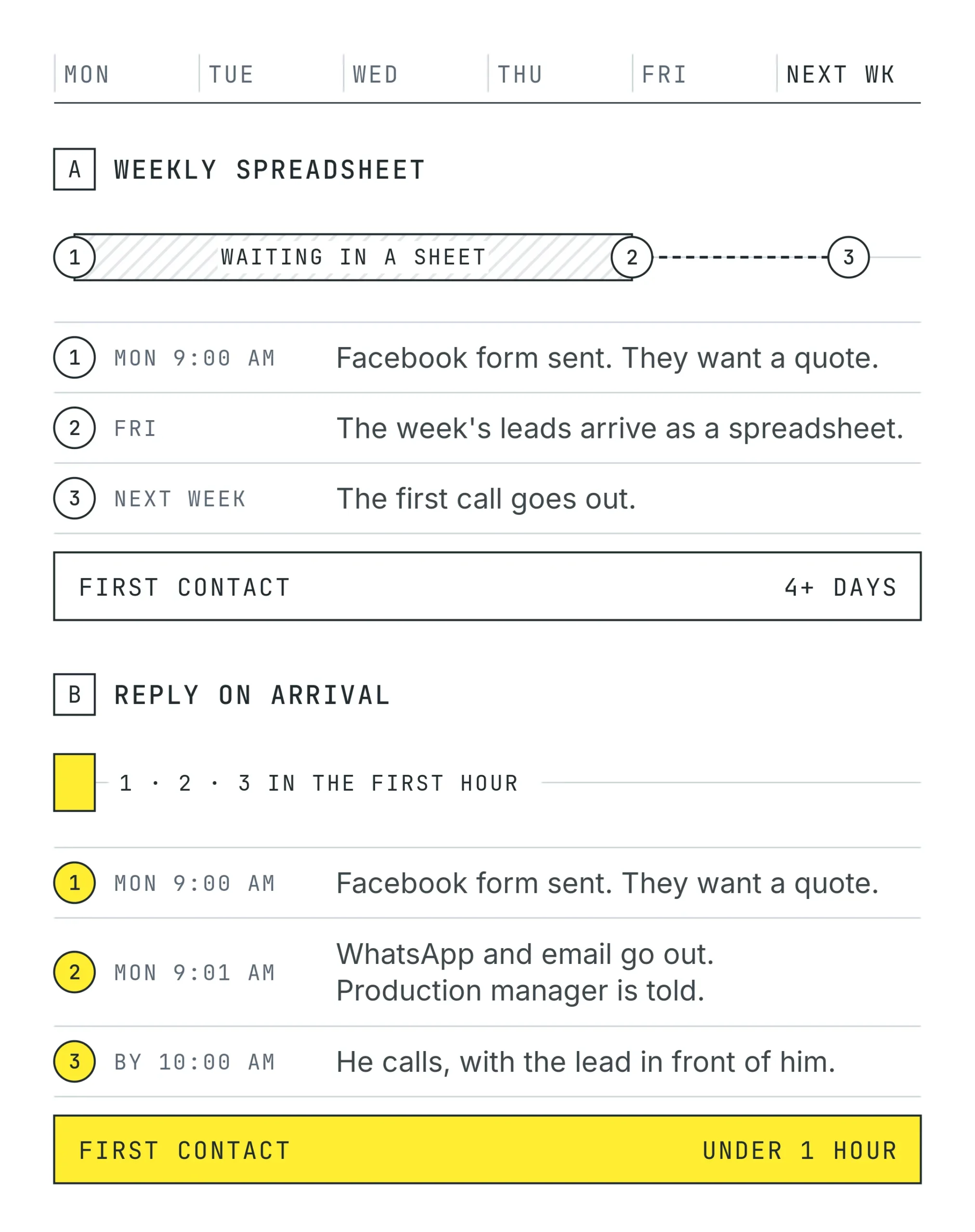
Nothing. The lead should never need handing over.
Here is what we set up for that client:
No spreadsheet. No waiting for Friday. That is the core of how we stop leads going cold.
The WhatsApp now goes out from the business, not a personal phone. The conversation stays with the business, whoever answers. We covered why in the handover is where the customer conversation gets lost.
The board fixes the agency relationship. Both sides see which leads became paid work, not just how many forms came in. The ads get judged on booked jobs.
We offered one more step. An AI assistant can reply to the lead, answer the first questions and offer a time. This client chose not to add it. If nobody on your team can call within the hour, it’s the next thing to look at. See what an AI employee actually does.
None of this is clever. Four days was slow, and the slowness was built into the week. The lead had nowhere to go between Monday and Friday. Now it has somewhere to go the minute it arrives.
Business texting works when the customer is already waiting for news. Six short texts cover most jobs, from the first reply to the review ask.
→
The next caller reads a bad review before they ring you. Answer it the same day, short and in public. Only a review that breaks Google's rules comes down.
→
Good work earns a review, but it rarely collects one. Ask every customer, on the day, with the link in the message. Then ask once more.
→
Rather talk than read
Tell us what is breaking and we will tell you what it would take to stop it.